RaphSammut.ca The Personal Blog of Raphael Sammut

2Sep/090

(Almost) Virtually Exploding Buildings

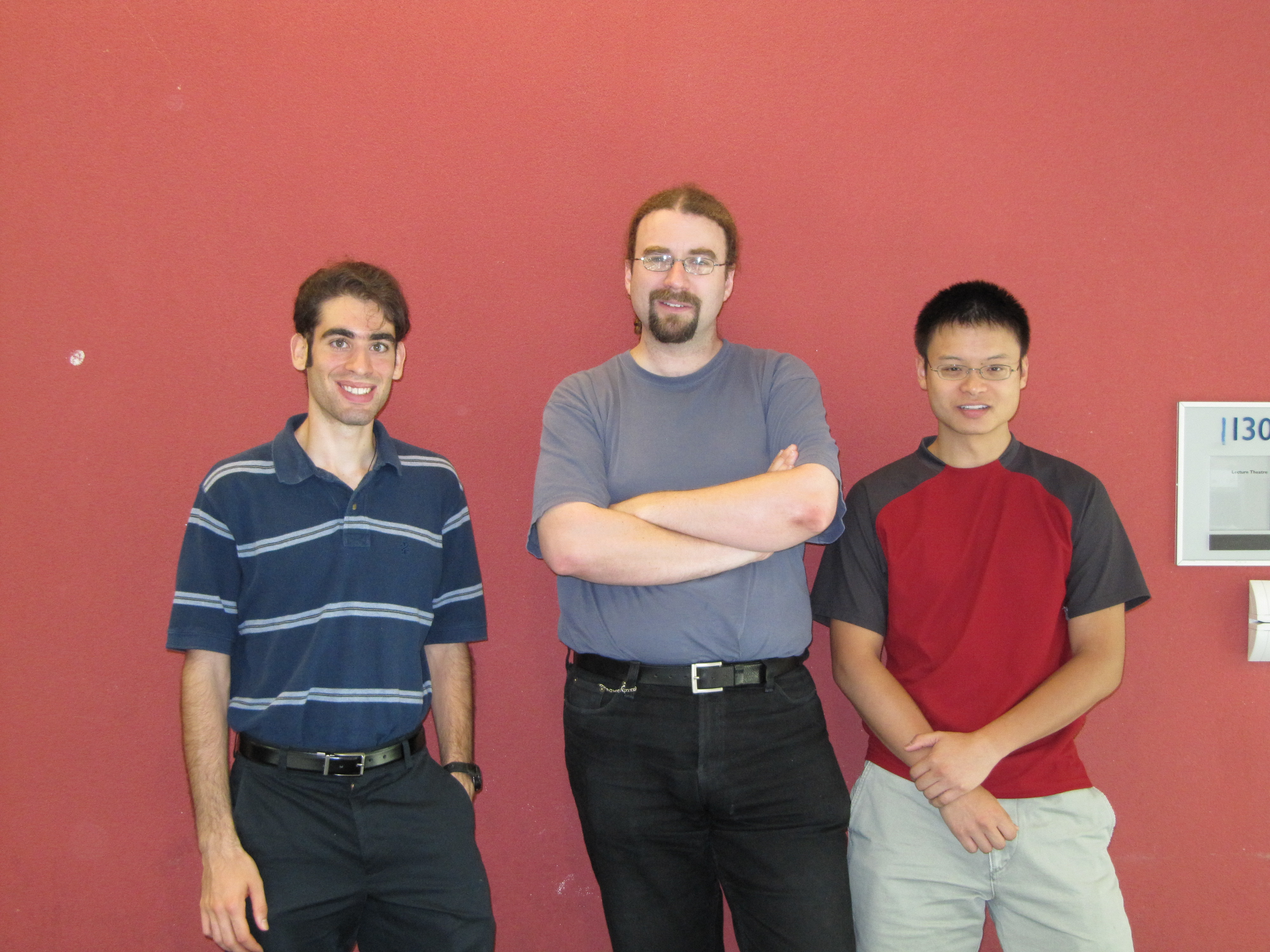
Professor Bentz with Drew and I

Professor Bentz with Drew and I.

This past summer, I had the opportunity to work with a prominent Civil Engineering professor at the University of Toronto. Professor Evan C. Bentz specializes in structural engineering, and his work focuses on developing software to aid in the analysis and simulation of structures. Professor Bentz has an incredible personality, great sense of humour, and can talk about almost anything to almost anyone for as long as he is able to talk and someone is able to listen. Some of the most interesting and random conversations of my entire life were had last summer in Professor Bentz’s office. This was my first research position, and I really lucked out because I got to work with some incredible people, and ended up doing something I found enjoyable.

My main projects this summer were centred around making Professor Bentz’s software run more efficiently and accurately. The software suite includes Membrane-2000 and Response-2000 for modelling walls, beams, and columns, and Augustus for assembling elements into a structure and running tests on them.

One particular project involved writing a Visual Basic script to accept data from a large spreadsheet database of experimental test results for beams and convert individual tests into a series of input files that could be read by the software. This allowed for an automated way of verifying the simulation test results with real data. Once completed, the macro generated all necessary files in under a minute for over 2000 entries, whereas it probably would have taken a year to do them all by hand.

My next project  was meant to push Augustus to its limits by designing and testing a model of a 20-storey apartment building in the Greater Toronto Area that Professor Bentz had previously done some analysis for. After three weeks of interpreting design drawings, mapping out the geometry of the structure, and defining all the structural elements, I excitedly pushed the button to run the tests and the software crashed. While it was disappointing not to get any results, it ended up leading to my most interesting and challenging project.

The core issue, or so we believe, with the Augustus software not being able to run the tests on the building was that the data that the software reads in is not stored efficiently. The software performs its analysis using the “Stiffness Method”, which is an easy way for a computer to calculate displacements on large structures. Every node, or point of interest, in the structure is represented by a number stored in a matrix. The matrix contains all the information about how each node has displaced as the tests run.

This issue lead to the development of a Genetic Algorithm (based on this blog post) to try and optimize the matrix before any calculations were run. After banging my head on a desk for about a week, things started to click, and the development began to progress fairly rapidly. By the end of the third week working on the project, we started getting some positive results that the Genetic Algorithm we implemented performed better than more traditional methods, but took significantly longer to execute (especially for matrices greater than 100x100 in size).

After spending a week on optimizing the algorithms used thanks to MATLAB’s handy profiler, the operation time was cut down significantly and our program could compute matrices up to 500x500 in size within a minute, even on a slow (1.86 GHz) processor.

The Genetic Algorithm project was the focus of a presentation I made at the Undergraduate Engineering Research Day at U of T, mainly since the use of genetic algorithms was such a novel and interesting approach to solving the matrix bandwidth reduction problem. The presentation, which was developed from 10pm – 3am the night before (since we only got results the same day) went very well and I was awarded the prize of a top presenter.

Overall my research experience was fun, challenging, and a great way to spend my summer. While I was paid roughly the same as when I was the Site Director for an entire YMCA camp, I had far less responsibility, got to work with some brilliant and dynamic people, and enjoyed the great flexibility in working hours that the academia world offers. My research team had very little supervision, and the vast majority of our work was all self-driven. The best part of the position was that I was constantly challenged. Whenever I began feeling comfortable and in control of a project, I was thrown something else that seemed impossible in the beginning, but was always successfully accomplished in the end. Furthermore, this project will serve as an excellent lead-in to my PEY work term in Spain with CYPE Ingenieros, and has opened the doors to future thesis work when I return to Canada in 2010 to finish my degree.

[nggallery id=3]

Print This Post Print This Post
22Jul/090

Preparing for a Professional Experience Year… in Spain!

A shot of Raphael in the Sicilian countryside.

Raphael in the Sicilian countryside.

It was two summers ago when visiting my family in Europe that I first got the travel bug. At the time, I had just finished my first year of Engineering Science and dreamed of working in Europe for a summer. The prospect of learning a new language, being immersed in another culture, and having the freedom to travel to many fascinating places has always excited me.

When it came time to decide if I was going to do a Professional Experience Year (PEY) term in third year, I came to the conclusion that I would either find a rewarding international experience to pursue or continue on to fourth year and complete my degree. As a student of the Infrastructure Engineering program, there were great opportunities to work in different countries and I applied to jobs in the both the United States and Europe.

Last December, I was hired to complete a 12-month work term in Alicante, Spain starting in September 2009. I'll be working with a local Spanish engineering firm called CYPE Ingenieros, S.A.. My main focus will be on the expansion of a CAD software that can automatically verify if the designs for a structure meet the building code in the country where it will be constructed. I'll be succeeding another Engineering Science Infrastructure student, Geoff Frost (0T9+PEY), who has worked at CYPE since September 2008. While I can't share my PEY experiences yet, you can follow me on my journey by visiting my blog at http://raphsammut.ca/.

Raphael receiving his first place prize at the Canadian Engineering Competitions in Fredericton, New Brunswick.

Raphael receiving his first place prize at the Canadian Engineering Competitions in Fredericton, New Brunswick.

In addition to finding work abroad, I was able to fulfill my appetite for travelling during the school year as well. This past winter, I competed in the University of Toronto Engineering Kompetitions (UTEK) and won first place in the Engineering Communication division for my presentation on emerging applications of RFID technology. This led me to compete in the Ontario Engineering Competitions (OEC) in Guelph where I won second place and qualified for the national level of competitions. At the Canadian Engineering Competitions (CEC), held in Fredericton, New Brunswick, I built upon all the feedback received from the earlier competitions and won first place along with a sponsorship to attend the first National Engineering Summit in Montreal held last May.

Currently, I am working with Professor Evan Bentz as a summer research student. My main projects have been related to the development of Augustus, a software suite that acts as a post-processor for the Finite Element Method (FEM) analysis of structural elements. Augustus has recently been expanded to allow easy modelling and simulation of entire structures.

Print This Post Print This Post
18Jul/094

It Was the Death Eaters!

Just got back from seeing Harry Potter and the Half-Blood Prince, and I thoroughly enjoyed it. My previous favourite in the series was Harry Potter and the Prisoner of Azkaban, but the new film has clinched my vote. The cinematography was excellent, the acting has improved, and the overall feel of the movie was true to the novel.  If you get a chance to see it in theatres, I'd definitely say it's worth it.

One detail remains fresh in my memory, and I feel like I must do it some justice. The movie opens (don't worry, I'm not spoiling anything important) right were it left off with Harry and Dumbledore facing a barrage of photographers in the Ministry of Magic following the official return of the Dark Lord. Shortly after, three death eaters streak across London (no, this is a PG film, I'm referring to how they fly around and leave a trail of black smoke behind them) and kidnap Olivander, the wandmaker from Diagon Alley. As they're flying back from their mission they pass by a very remarkable and unique structure: The Millennium Bridge. Shortly after whizzing past the bridge, it begins to shake uncontrollably, its load-bearing cables snap, and the entire bridge collapses into the Thames river.

The Millennium Bridge, following its collapse in the movie, "Harry Potter and the Half-Blood Prince"

The Millennium Bridge, following its collapse in the movie, "Harry Potter and the Half-Blood Prince"

So, what's so special about this bridge? If you're from the UK, or happened to be around when the bridge was officially opened, you probably would have found its collapse in the movie ironic, amusing, and incredibly brilliant.

Click to continue reading "It Was the Death Eaters!"

Print This Post Print This Post
Page 2 of 212